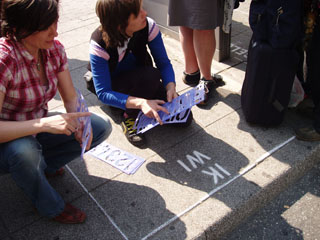
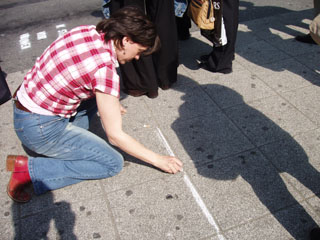
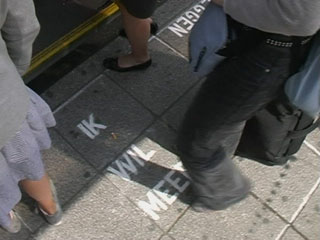
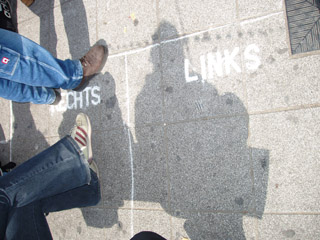
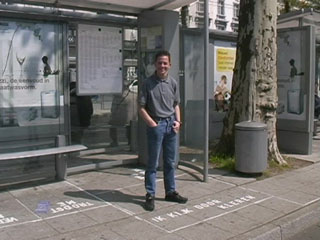
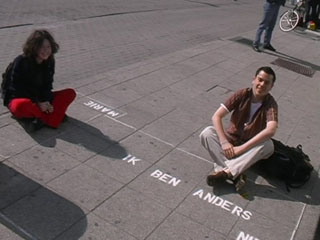
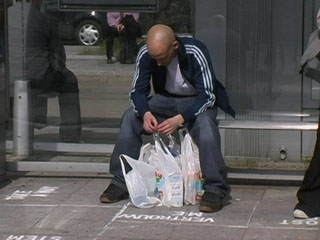
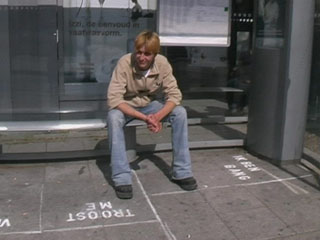
| Project Description: Starting from the well know child street play "Hopscotch", we modified the public space of a well know transit point in Gent. We marked zones around and through the bus stop with chalk, adding text labels instead of numbers used in the original game. Some texts are descriptive about the person standing on the spot: "I can read your mind", "I'm scared", "I can look through clothes" or "I'm God". Others are an invitation or message to others, like: "For sale", "Come closer" or "Trust me". Some are pointers to the physical and mental map of the spot, e.g. around a bench it reads "I'm tired" and far away from the bus stop"Leave me alone". We want to make the user aware about how they are relating to others, in this determined public space. A bus stop is a place they cannot easily escape (or they miss the bus), a physical and psychological space with unpredictable group dynamics. We want to make users aware of this everyday social game and make available for them a medium of non-verbal communication based on the use of physical location. This way waiting becomes a meaningful act which enables communication. This work addresses the topic of social labeling. We are trained by society to judge people all too easily by social codes like clothes and gesture expression. We want to make the user question this different kind of social labeling inflicted on them.
Location:
Bus stop area at the Zuidplein, Gent, Belgium.
Location Description:
This area acts like a transit hub for the neighborhood, with busses and trams coming and going.
User Experience:
People choose a specific place when arriving at the bus stop. They take position, most of them unaware of the social and psychological consequences of this choice. Once they notice they're labeled, they can ignore it, or react in some way: some might move, some might stay and reflect about the work or communicate about it with nearby people that are identically labeled. Technical Description:
Chalk on stone.
Team Description:
Ann Langelet
Marthe Van Dessel
Thomas Laureyssens Motivation:
We want to make people reflect about they behavior through introducing a social game in a public place. Will they interact? We want this already so structured city give a more childlike and playful look.
Who does the project benefit? Who is it for (audience)?
Commuters, passerby's
What aspect of "community" does it address?
Communication and social awareness. The work can act as a catalyst for micro-level community building.
What is the life span of the project? How does it exist elsewhere?
How does it exist beyond the workshop?
Chalk is easily dissolved in rainwater and wiped out by footwork, so we expect the work to totally dissolve in 2 days depending on the weather and commuter load. More locations could be analyzed and enhanced.
Photos:
640 x 480 images here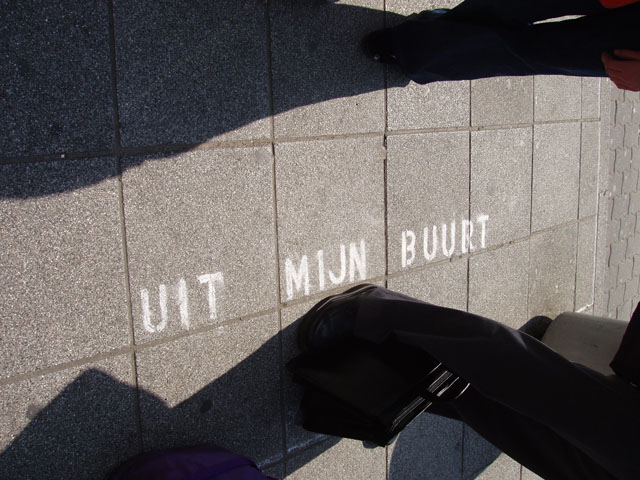 | 640 x 480 images here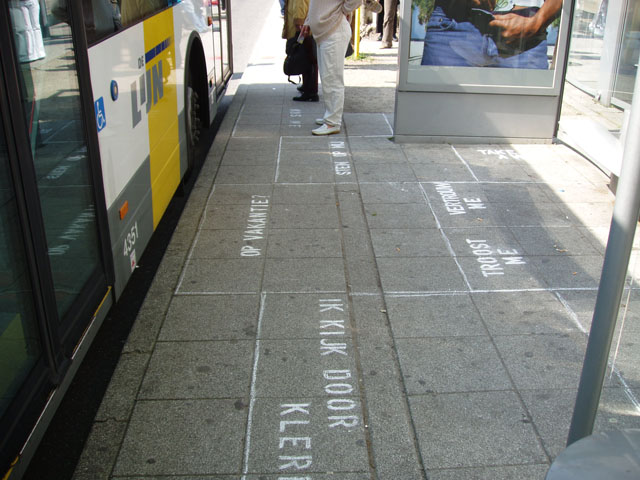 |
Other Thoughts:
Nancy Mauro-Flude proposed to play the "in between". She makes registration of what happens in this social game, she records what is happening as a pedestrian. By using a 2.4ghz wireless camera that is attached to her body, Nancy occupies the only free public airwave left. She moves through this uncolonised frequency, this in between space, and records the intervention with the public at the bus stop - an in between ephemeral space as well. You can read more about her work.
References: (urls, projects, books)
|